STORY OF THE MONTH
When Quantum Pulses Remembers: Source Correlations in High-Speed QKD
 Aug 2026
  Shashank Kumar
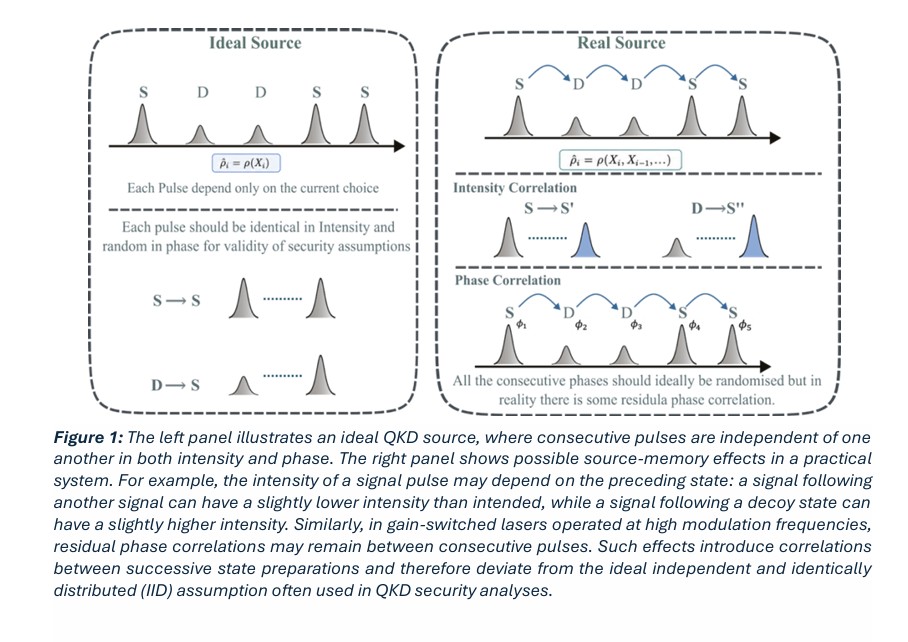
Quantum key distribution (QKD) derives its security from the precise quantum states prepared and transmitted by Alice. Ideally, every transmission round should be considered independently: once Alice chooses an intensity, phase or quantum state, the pulse she generates should depend only on that choice.
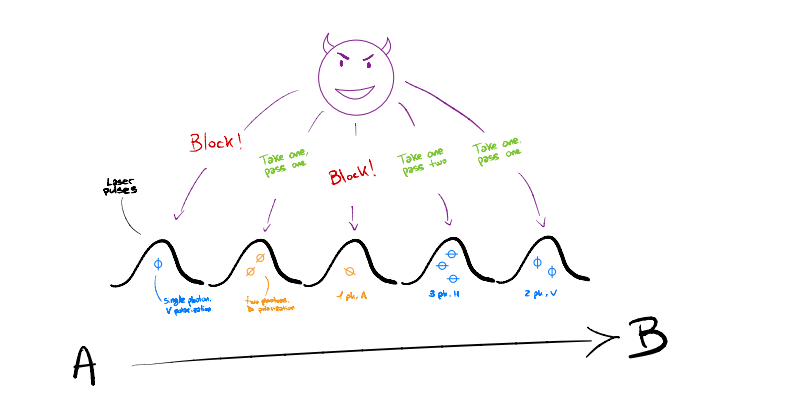
Real devices, however, can behave differently, especially when operating at gigahertz speeds1. Electronic drivers, modulators and optical sources have finite response times. As a result, the state of one optical pulse can depend slightly on what happened in the previous transmission rounds. In other words, the transmitter can have a memory.
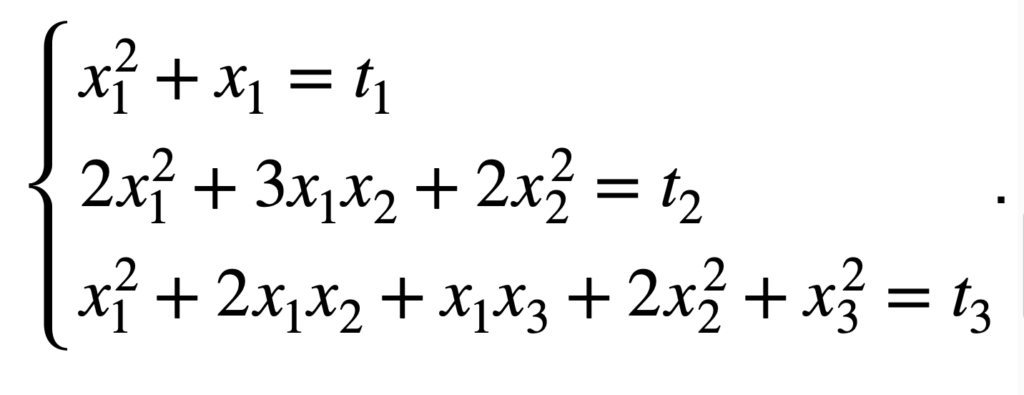
This memory can appear in several properties of the emitted quantum states. One example is intensity correlation. In a decoy-state QKD protocol, Alice may randomly switch between signal and decoy intensities. Ideally, a signal pulse should have the same characteristics regardless of whether the previous pulse was another signal or a decoy. In practice, however, we can have

meaning that two pulses carrying the same intended intensity are physically different simply because they have different histories.
A similar problem can occur in phase2,3. Optical pulses generated at a very high modulation frequency may retain some degree of phase coherence, or the phase prepared in one round may influence the phase generated in the next. The current quantum state can therefore contain information about previous preparation choices.
Why does this matter?
QKD security proofs rely on a mathematical model of the quantum states leaving the transmitter. If two states that Alice considers identical are distinguishable because of their history, an eavesdropper could, in principle, obtain information that was not intended to be encoded. The presence of correlations does not automatically make a QKD system insecure, but it means that these correlations must be properly understood and included in the security description.
Phase correlations provide a good example of how the physical light source itself can play an important role. In our previous work, we demonstrated a GHz-rate QKD source based on a super luminescent light-emitting diode4 (SLED). Because the SLED is based on amplified spontaneous emission, consecutive emitted pulses exhibit negligible first-order phase coherence, providing intrinsic global phase randomization. At the same time, the required coherence between the early and late time bins of each encoded quantum state can be generated using an interferometer.
This addresses one important source of pulse-to-pulse phase correlation without relying on active phase randomization.
Intensity correlations, however, remain a broader challenge in practical high-speed transmitters, particularly when active modulation is used.
Together, these effects highlight an important aspect of practical quantum communication: generating the correct state is not enough, we must also understand whether that state carries a memory of those that came before it.
As QKD systems continue toward higher clock rates and increasingly integrated hardware, understanding such source correlations becomes essential for connecting the ideal assumptions of quantum cryptography with the behavior of real devices.
References
- M. Pereira, G. Kato, A. Mizutani, M. Curty, and K. Tamaki, “Quantum key distribution with correlated sources,” Sci. Adv. 6, eaaz4487 (2020).
- A. Agulleiro, F. Grünenfelder, M. Pereira, G. Currás-Lorenzo, H. Zbinden, M. Curty, and D. Rusca, “Modeling and characterization of arbitrary order pulse correlations for quantum key distribution,” arXiv:2506.18684 [quant-ph] (2025).
- A. Marcomini, G. Currás-Lorenzo, D. Rusca, A. Valle, K. Tamaki, and M. Curty, “Characterising higher-order phase correlations in gain-switched laser sources with application to quantum key distribution,” EPJ Quantum Technol. 12, 38 (2025).
- S. Kumar, A. Marcomini, L. Millet, T. Taher, A. Cavalié, R. Houlmann, D. Cabrerizo, G. Boso, M. Curty, R. Thew, B. Korzh; Phase-correlation-free quantum key distribution source operating at gigahertz rates. APL Photonics 1 August 2026; 11 (8):https://doi.org/10.1063/5.0347954
OTHER STORIES